

Codegen was a company I founded to build level 5 self-driving for software engineering. We launched the first asynchronous coding agent, tightly coupled with Linear and Slack, at a time when the vast majority of developers were only leveraging AI for in-IDE completions, and maintained a leading code agent offering until the end of 2025.
We were backed by Thrive Capital and customers included Ramp, Notion, Ironclad, Origin Financial, ClickUp, Ghost and many more. Codegen was ultimately acquired by ClickUp in late 2025, where it now powers ClickUp Brain and I serve as Head of AI.
This is a short retrospective on what we built, what we learned, and where the ideas live on.
Skating to where the puck was going
We started Codegen when gpt-3.5-turbo was the best model available. The models were nowhere near good enough to do this well yet — but the trajectory was unmistakable. In-IDE assistants were obviously about to hit product-market fit, and it was clear that "AI that writes code" would be one of the defining categories of the coming years.
So we bet on where the puck was going rather than where it was. We started building autonomous software engineering agents on the assumption that the underlying models would catch up — and they did.
The thesis
Codegen was a bet on a trajectory. We believed we'd see steadily increasing levels of agent capability, and that even in 2024 a large set of real engineering tasks already fell below the high-water mark of what LLMs could do. The implication was clear: the engineer would be progressively eliminated from the inner loop, and agents would take on increasing autonomy over time.
We also reasoned that the best way to build for this future was to meet users on the surfaces they already collaborated on — Linear, Slack, and pull requests — rather than leaning into a bespoke IDE. Instead of pulling engineers into a new tool, we let agents collaborate across the artifacts teams already worked with, so the human stayed in the loop only where their judgment mattered most.
What we built
- Async coding agents that operated like teammates — picking up tickets in Linear, collaborating in Slack, opening PRs, and iterating on feedback.
- Enterprise deployments handling real platform work — large-scale migrations, dead-code removal, dependency cleanup, and type-coverage enforcement.
- A spin-off library, graph-sitter, for programmatic codebase refactors (see the highlight below).
Milestones & links


Fundraise announcement
TechCrunch — Codegen raises new capital for LLM automation in software dev.

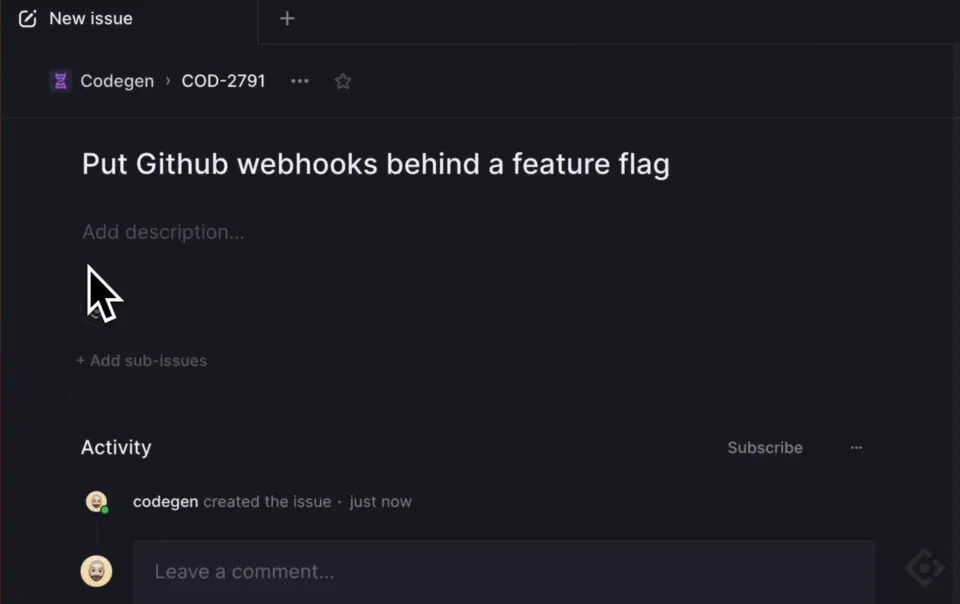
Original demo: ticket → PR
November 2023 — the first ticket-to-PR demo, built and used internally at Ramp.

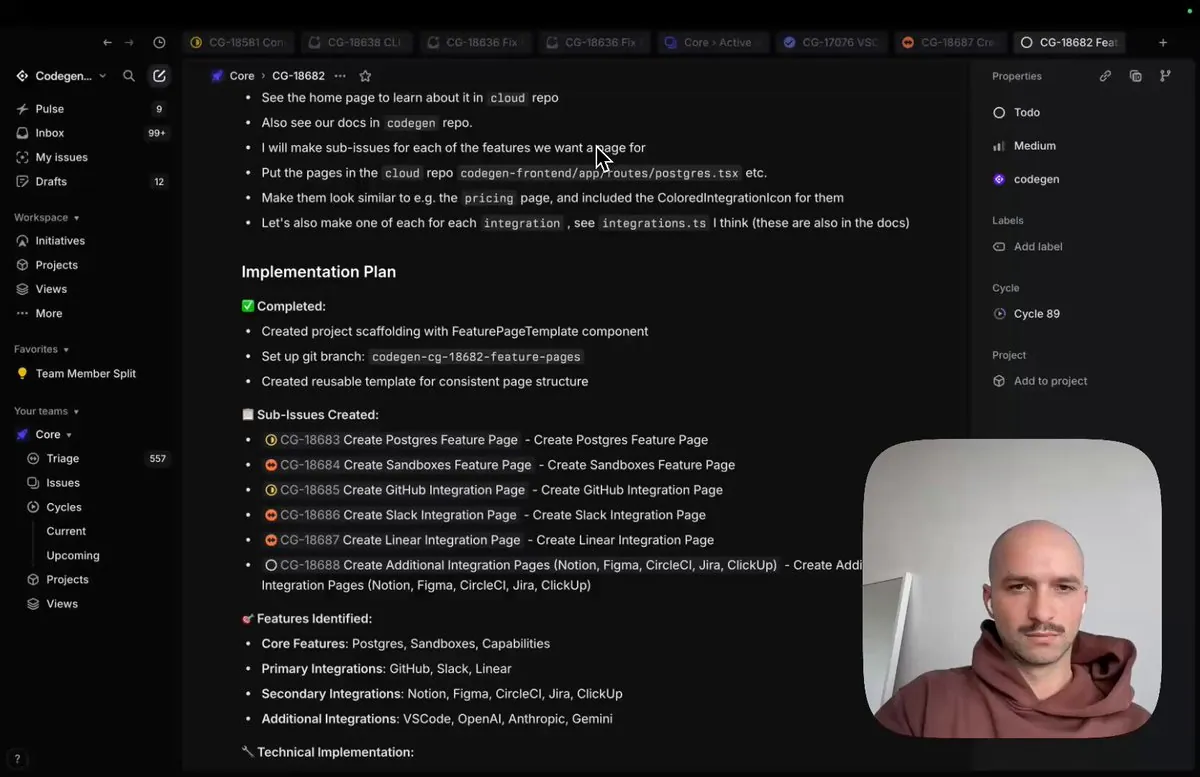
Multi-agent demo flow
Multiple agents collaborating across a single coding workflow.


Acquisition announcement
Codegen joins ClickUp in 2025.


Documentation
Product overview and developer docs.


GitHub
Open-source work from the Codegen team.
Spin-off: graph-sitter
Along the way we took a detour to build graph-sitter, an open-source library for programmatic codebase refactors built on top of Tree-sitter. It became the foundation for our "act via code" thesis.

graph-sitter — a library for codebase refactors
Visit the project site and docs for the open-source framework behind Codegen's agents.
Where it lives now
In 2025, Codegen was acquired by ClickUp, and the team came together to build agents for general-purpose knowledge work. The agent product continues as Codegen inside ClickUp Brain.
It was a privilege to build with this team. More to come.
Jay Hack, Founder